What You See in the Card
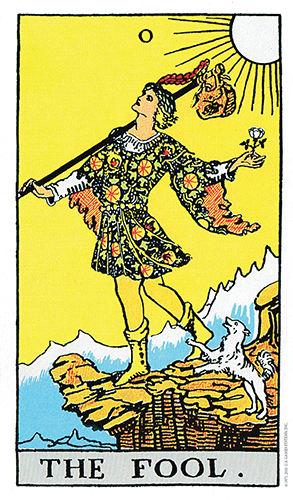
The Fool stands at the edge of a height, close to stepping into the valley below. He looks upward rather than down, carrying a small bundle over his shoulder and a white rose in his hand. A white dog moves beside him. The sun shines above, and the mountains rise behind him.
This image is built around the moment before incarnation into experience. The Fool has not yet entered the full weight of the physical world. He is still light, open, inspired, and untested. The valley below represents ordinary material life: the world of consequences, choices, relationships, bodies, money, work, desire, pain, and growth.
The mountains behind him can be read as the spiritual heights he has left behind and will spend his life trying to reach again, but now through lived experience rather than innocence. The card is therefore not only about going forward. It is about descending into life in order to become conscious.
The Number 0 and Unlimited Potential
The Fool is marked with the number 0. This is essential to the meaning of the card. Zero describes unlimited potential: the state before form, before definition, before life has narrowed possibility into one path.
Because The Fool is not bound to the numbered sequence in the same way as the other Major Arcana cards, he can stand at the beginning of the journey and also at its end. He is the one who begins, but he is also the free spirit that remains present through every stage. The Fool does not need a fixed number because he is the journey itself.
Like a newborn entering the world, The Fool faces a field of possibilities. Nothing has yet been proven. Nothing has yet been lost. He carries the potential to become many things, but the direction of that potential depends on choice. This is why the card is both innocent and serious. Freedom is a gift, but it also demands wisdom.
The Core Meaning
The Fool appears when life is asking for movement before full certainty. It marks a threshold: a new path, a new self-image, a new relationship to risk, or a choice that cannot be solved by overthinking.
In a healthy form, The Fool is courage, openness, trust, curiosity, and the willingness to begin. In an immature form, it can be avoidance, denial, impulsiveness, or a refusal to look where the next step actually lands.
The Fool is the beginning of every creation. He is the impulse to step toward a goal before the mind has built a complete map. He represents the vitality we feel at the start of an adventure: the quickened heartbeat, the physical excitement, the sense that something new is calling and that staying still is no longer possible.
At the same time, The Fool has no real life experience yet. He does not naturally calculate delays, complications, or dangers. This is the double nature of the card: inspired faith on one side, blind faith on the other.
The Fool in the Major Arcana Journey
The Fool is the soul before it has been trained by the world. He has not yet learned the language of power, fear, duty, love, failure, or consequence. This is why the card can feel both beautiful and dangerous. It contains the freshness of beginning, but also the blindness of beginning.
In the journey of the Major Arcana, The Fool is the one who will meet every other card. He will meet The Magician and discover will. He will meet The High Priestess and discover inner knowledge. He will meet The Emperor and discover structure. He will meet Death and discover transformation. The Fool is not separate from the journey; he is the traveler inside it.
When The Fool appears in a reading, the question is not only whether to begin. The deeper question is: which part of you is being asked to trust life again, and which part of you is avoiding responsibility by calling it freedom?
Upright Meaning
Upright, The Fool often says: start, but stay awake. It can point to travel, a new relationship, a creative beginning, a business idea, a spiritual opening, or a phase where the old rules no longer fit.
The card does not promise that the path is simple. It says the first step matters. The question is whether the person is moving from trust or from escape.
Reversed Meaning
Reversed, The Fool can show two opposite problems. Sometimes the person is frozen at the edge, afraid to begin. Sometimes they have already stepped forward without looking.
In readings, the reversed Fool often asks for a reality check. What information is being ignored? What consequence is being avoided? What risk is worth taking, and what risk is only restlessness wearing the mask of freedom?
Symbolic Details in The Fool
The sun above The Fool illuminates the beginning of his adventure. It gives warmth, life, and blessing to the journey. The Fool is not stepping into darkness; he is stepping into the unknown under the light of possibility.
His direction matters. He turns toward the unknown and looks upward, toward the sky, rather than down at the edge beneath him. This upward gaze shows aspiration, trust, and spiritual focus, but it also reveals the risk of not seeing what is immediately in front of him.
The white rose in his hand represents purity, innocence, and the clean desire at the heart of the journey. It is the ideal he follows. But the rose also carries another message: beauty has thorns. The Fool must learn that devotion to a pure aim still requires attention, practicality, and care.
The cliff is the edge of the known world. It is not only danger; it is the point where potential must become experience. The Fool cannot remain innocent forever and still develop. The step into the valley is the step into life.
The Dog, the Bundle, and the Rose
The dog beside The Fool is one of the most layered symbols in the card. Dogs often represent loyalty, instinct, companionship, and devotion. Here the dog may be the faithful guide that accompanies the soul when it follows its true path.
In some readings, the dog is also a warning. It may be trying to pull The Fool back from the edge or alert him to danger. This makes the dog a symbol of instinct: the part of us that feels what the conscious mind refuses to notice. In other interpretations, the dog can represent pressure, disturbance, or an outside force that challenges the Fool at the moment of departure.
The bundle on The Fool's shoulder can be read as the past he carries with him. It may contain memory, karma, inherited patterns, and the unfinished material he will meet along the way. It is small, but it matters. The Fool begins lightly, yet he does not begin with nothing.
The staff itself creates a symbolic line through time. The Fool holds it in the present. The bundle behind him suggests the past. The direction ahead suggests the future. He is suspended between what he carries and what he has not yet become.
The white rose is the force that moves him forward. It is innocence, desire, beauty, and the ideal worth pursuing. But it also teaches discernment. A pure goal does not remove the need for wisdom. The Fool must learn to honor the rose without ignoring its thorns.
How The Fool Changes Inside a Spread
Near cards of stability, such as The Emperor or Four of Pentacles, The Fool may show the need to loosen control. Near cards of confusion, such as Seven of Cups or The Moon, it may warn against fantasy. Near cards of action, such as The Chariot or Ace of Wands, it can support a brave beginning.
In a past position, The Fool can show the moment everything began, sometimes with innocence and sometimes with carelessness. In a present position, it shows the user standing at a threshold. In a future or advice position, it asks for movement, but not unconscious movement.
Love, Career, and Yes-or-No
In love, The Fool can show a fresh connection, a leap of faith, or someone who wants freedom more than definition. It is exciting, but it needs honesty. If the question is about commitment, The Fool may say the bond is still in its beginning stage.
In career, The Fool points to new work, a pivot, a launch, study, relocation, or a chance that requires learning as you go. It favors beginnings, but not careless planning.
For yes-or-no questions, The Fool usually leans yes when the question is about starting, exploring, trying, or opening a door. It leans caution when the question asks whether something is already stable, proven, or ready for long-term commitment.