What You See in the Card
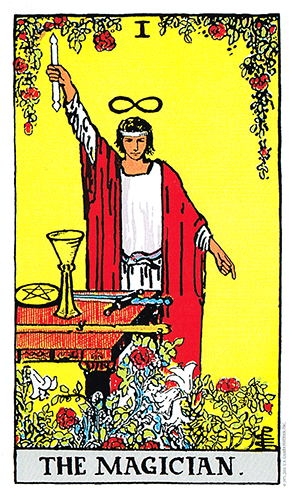
The Magician stands before a table holding the four suit symbols: wand, cup, sword, and pentacle. One hand points upward and the other downward. Above his head is the infinity sign. Around his waist is the ouroboros, the serpent biting its own tail. Around him are red roses and white lilies.
The image is built around connection. Above and below. Intention and matter. Spirit and technique. The inner idea and the outer act. The Magician does not wait for the world to define the situation; he shapes it.
This is a figure of confidence and mastery. The Magician knows the patterns inside himself and around him. He understands the elements he is working with, and he has the will to combine them into something that did not exist before.
The Number 1 and the Power of Initiative
The Magician carries the number 1. After the unlimited potential of The Fool, the number 1 gives direction. It represents independence, individuality, creation, initiative, and the first act of self-definition.
This card is therefore deeply connected to action. It is creative, active, and traditionally masculine in the symbolic sense: not male as a person, but initiating, projecting, shaping, and changing circumstances.
The Magician is self-aware and concentrated in the present. He does not scatter himself across regret or fantasy. The tools are in front of him, the goal is clear, and he knows which direction to take.
The Core Meaning
The Magician appears when potential is ready to become action. It is not only manifestation in the vague modern sense. It is skill, focus, timing, communication, and the ability to use what is already available.
The card asks: what tool is on the table that you are not using? Sometimes the missing piece is not more opportunity, but clearer intention.
The Magician is not powerful because he forces reality by brute strength. He is powerful because he governs his own thoughts, intention, words, and attention. In simple terms: he controls the inner current, and therefore he can influence the outer form.
This card reminds us that we are not only victims of circumstance. We carry resources, instincts, talents, language, imagination, and practical ability. The question is whether we are using them consciously or allowing life to use us unconsciously.
The Magician in the Major Arcana Journey
After The Fool steps into the journey, The Magician is the first encounter with directed will. The Fool has potential; The Magician knows how to shape potential. The Fool begins; The Magician chooses how to begin.
This makes The Magician a card of embodiment. The idea must become speech, gesture, decision, technique, craft, or action. Nothing remains abstract for long under this card. It asks the user to stop treating desire as a dream and begin treating it as a practice.
In the soul journey, The Magician is the discovery that life does not move only through fate. The person has tools. The person has influence. The person can name, arrange, speak, choose, and create.
Upright Meaning
Upright, The Magician is agency. It can show a strong beginning, persuasive communication, entrepreneurship, study, craft, sales, negotiation, creative production, or the need to act with precision.
In a reading, it often means the person has more power than they are admitting. The situation may not be complete yet, but the ingredients are present.
Reversed Meaning
Reversed, The Magician can show scattered power, unused talent, poor timing, manipulation, mixed signals, or someone using charm without substance.
It can also point to impostor syndrome: the tools are there, but the person does not trust their ability to use them. The reversal asks whether energy is being focused or leaked.
Symbolic Details in The Magician
The table contains the four suits: wand, cup, sword, and pentacle. These are also the four elements: fire, water, air, and earth. The wand carries will, inspiration, and the force that can make miracles possible. The cup carries imagination, emotion, and receptivity. The sword carries thought, language, clarity, and decisive action. The pentacle carries matter, results, money, body, and the final form of effort.
The Magician is the master of these elements. He knows that each element alone is simple, but when they are combined consciously they become alchemy. Desire without thought burns out. Thought without emotion becomes cold. Emotion without grounding becomes fantasy. Earth without inspiration becomes repetition. The Magician unites them.
One hand points upward and the other downward. This gesture suggests a channel between the invisible and the visible: idea into form, intention into action, intuition into language, desire into structure. It is the principle of "as above, so below": heaven and earth, spirit and matter, inner and outer reality.
The infinity sign above the head speaks of endless energy, continuity, and the force that cannot truly be created or destroyed, only directed. It also shows the Magician's understanding that thought creates consequences. In some traditions, a similar sign near the throat emphasizes the infinite power of the spoken word.
The red and white colors are also important. White represents purity, clarity, and spiritual intention. Red represents desire, will, passion, and life force. The Magician wears white beneath red: a pure inner intention covered by active desire. The red roses and white lilies repeat the same teaching: passion must be guided by clean thought.
The Ouroboros and the Cycle of Transformation
The belt around The Magician's waist is often read as an ouroboros, the serpent that swallows its own tail. This ancient symbol represents cycles, transformation, renewal, and the self-feeding nature of energy.
The ouroboros expresses birth, becoming, death, and rebirth. It shows that creation is not a straight line. Every act of manifestation belongs to a cycle: an idea appears, takes form, completes itself, dissolves, and returns as new material for the next creation.
For The Magician, this symbol is a source of power. He understands that renewal is happening at every moment. He does not wait for life to become perfect before acting. He works with the living cycle of change.
The ouroboros also points to unity: everything is connected. The inner world and outer world are not separate. Thought, word, action, and result belong to one current. This is the philosophy behind The Magician's power.
The Shadow of The Magician
The shadow of The Magician is manipulation, performance without substance, scattered energy, or the use of language to control rather than reveal. A reversed or badly placed Magician can describe charm that hides emptiness, promises without follow-through, or a person who knows how to appear powerful but avoids real responsibility.
On an inner level, the card can point to unused talent. The user may already have the tools but keeps waiting for permission, certainty, or a perfect moment. In that case, The Magician does not flatter; it confronts. It says: the table is not empty, so why are you still acting as if you have nothing to work with?
How The Magician Changes Inside a Spread
Near Pentacles, The Magician becomes practical: business, work, money, production, measurable progress. Near Cups, it becomes emotional communication, attraction, influence, or healing through honest expression. Near Swords, it becomes language, strategy, persuasion, writing, decision, or mental clarity. Near Wands, it becomes initiative, charisma, creativity, and bold movement.
In an advice position, The Magician often asks for focus and one clear action. In an obstacle position, it can show scattered effort or someone using words without integrity. In a future position, it suggests that the situation can be shaped, but only if the user participates consciously.
Love, Career, and Yes-or-No
In love, The Magician can show attraction, chemistry, strong communication, and someone who knows how to create an opening. Reversed, it asks whether the words match the behavior.
In career, this is one of the strongest cards for launching, pitching, building, selling, writing, teaching, or presenting. It favors action backed by skill.
For yes-or-no questions, The Magician usually leans yes when the question involves initiative, communication, or using available resources. It leans no or not yet when the situation depends on someone else becoming honest, consistent, or capable.